
この記事の翻訳は確認中です。以下に英語原文を掲載しています。 English →
Reservoir wind · 2026-07-18 · 11 min read
Wind gives a reservoir direction
How wind changes surface movement, boat or bank position and the order in which open freshwater can be searched.
ROCK CURRENT Research Notes
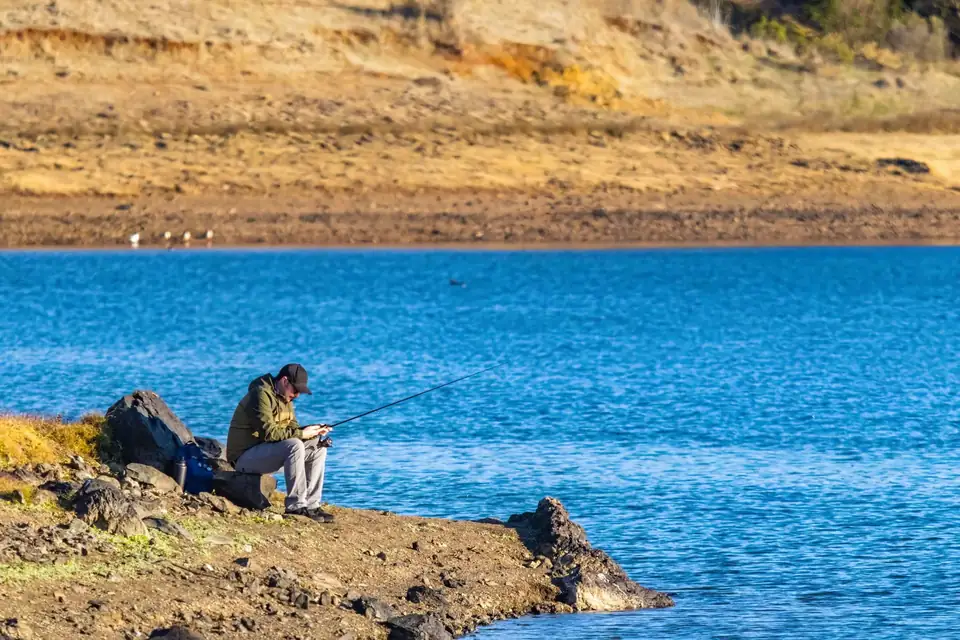 Context photograph · source record retained
Open water is not directionless
A reservoir can appear static because its shoreline does not visibly carry water downstream. Wind changes that impression. Friction transfers energy to the surface, creating waves and moving the upper water. The response depends on wind strength, duration, fetch, basin shape and depth. A breeze across a sheltered arm is not the same event as sustained wind travelling the long axis of an open basin. The visible chop is therefore evidence of energy and direction, not a complete map of water movement below it.
Treat wind as a layer added to structure. A point still has a break, a creek arm still has a channel and a retaining wall still has an edge, but wind changes how the surface approaches them, how a boat drifts and how line behaves between rod and lure. Instead of asking whether wind is simply good or bad, ask what direction it gives the present search and what parts of the reservoir have become more or less controllable.
Fetch explains why equal wind feels unequal
Fetch is the distance over which wind acts across water in a broadly consistent direction. More available distance and time can build a larger surface response, while islands, bends and high banks interrupt it. Two banks under the same forecast can therefore feel entirely different. One may receive developed waves; another may hold only short, confused ripples. Forecast speed is planning information. The actual water shows how basin shape has translated that speed at a particular place.
Before selecting a bank, trace the wind across a map and then verify it from a safe viewpoint. Look for protected corners, exposed points and transitions where the wave pattern changes. These transitions can organize a search, but they are not automatic fish locations. They tell you where line control, lure speed, turbidity and access may change. Each of those variables needs its own observation instead of being collapsed into the familiar phrase “wind-blown bank.”
Wind changes the path before it changes the lure
From shore, a crosswind can bow line before the lure reaches working depth. The bow changes contact, retrieve angle and the speed at which a lure rises or swings. Casting lower, shortening the working distance or repositioning may recover control more effectively than adding weight. Added mass can help, but it also changes fall, snag risk and the route that remains usable. The correct adjustment is the smallest one that restores a legible path.
From a boat, wind acts on hull and exposed body while current may act differently below. The resulting drift is a combined movement, not a direct copy of the wind arrow. Observe the vessel against a fixed shore reference, compare the first drift with the second and follow the captain’s limits. If speed or wave angle makes standing, casting or returning uncertain, the method ends there. Productive-looking water does not cancel a loss of control.
Build a search order around exposure
Divide the reservoir into three practical zones: protected, transitional and exposed. Begin where control is sufficient to create a repeatable pass. In protected water, subtle line and depth changes may be easier to read. At the transition, compare how chop, clarity and drift begin to change. In exposed water, only continue when footing or vessel control remains secure and the presentation still answers a defined question. More disturbance is not automatically more information.
Within each zone, connect wind to existing structure. Does it approach a point along the contour or cut directly across it? Does it run parallel to a retaining wall, enter a creek arm or pile surface debris against a corner? Use one lure path to establish contact and one to compare angle. Change depth before colour when the first concern is where the lure travelled. The sequence turns a large reservoir into a small set of comparable routes rather than a chase after visible waves.
Record the wind that actually arrived
A useful note keeps forecast and observation separate. Record the source and time of the forecast, then note observed direction, approximate consistency, wave pattern, water clarity, access and the path sampled. Avoid inventing precision when no instrument was used. “Intermittent crosswind with short chop” is more honest than a numerical claim copied from a distant station and presented as if it described the exact bank.
On a return visit, compare equivalent zones rather than forcing the old bank to repeat. The same forecast can meet another water level, vegetation line or boat position. Let the new conditions revise the order. Wind gives a reservoir direction, but it does not write the conclusion. Its value is that it narrows attention: identify exposure, preserve control, connect movement to structure and make each pass accountable to the water present now.
Keep negative results in the same record. A route that could not hold depth, a bank abandoned because the return became difficult, or a drift stopped when wave angle changed is useful information. It defines the operating boundary of the method and prevents a later reader from seeing only the casts that looked successful. Note whether the limit came from footing, vessel control, line behaviour or visibility; those causes imply different future decisions. Over several visits, compare decisions before outcomes: where control was established, which variable was changed and when safety ended the sequence. That comparison can improve the next plan without pretending that wind, structure and fish response form a simple universal formula. It also makes a cancelled cast part of the method rather than an empty space in the story. The best record explains clearly why the sequence stopped.